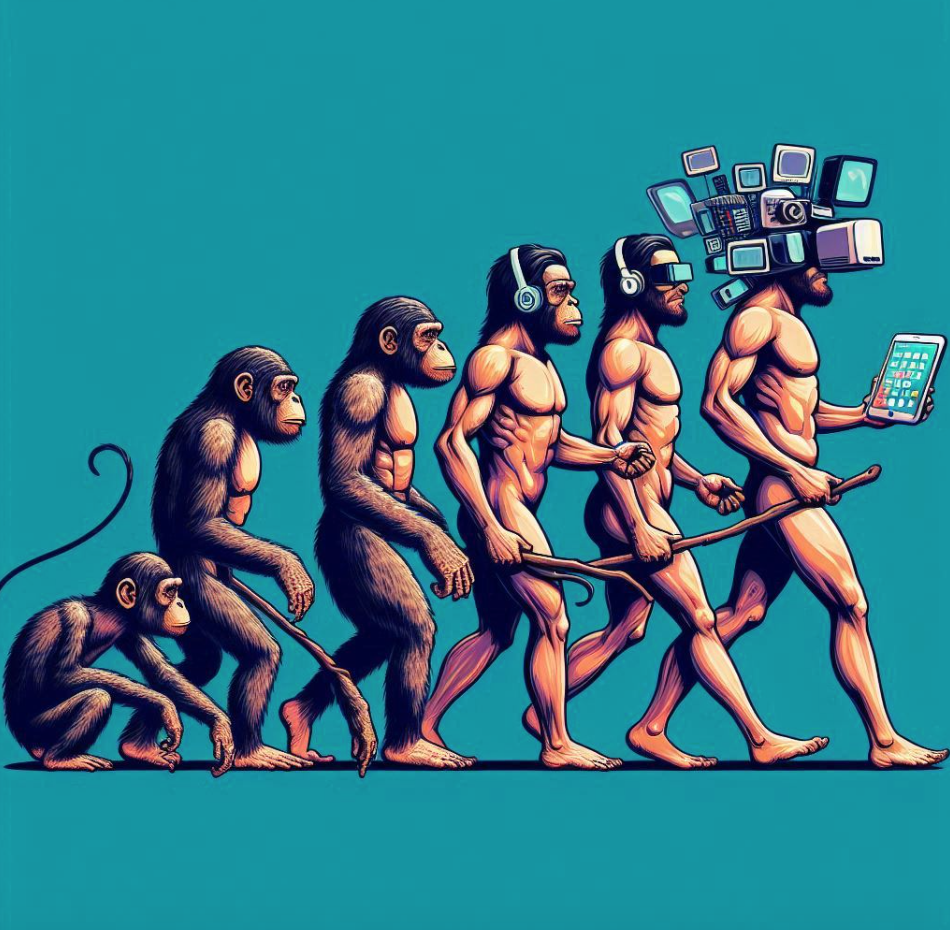
I’ve long had a thesis that “The Screens are Marching Closer.”
The screens are marching closer means each successive iteration of tech interfaces will prioritize ease and intuition by bringing the screens closer to our face (and one day inside them with brain-computer interfaces).
It’s what has me so convinced that typing into a chatbot isn’t the future of generative AI. Voice and eye control are the next phase.
Typing is clunky, quickly becoming outdated, and doesn’t represent our most intuitive senses nor match where technology is heading. Voice input is already the default for younger generations – gaming consoles, remotes, and virtual assistants. Thumbs are old-school.
Here’s why:
1) The hierarchy of senses generally places sight and auditory as the most specialized senses. Many argue sight and auditory are the most specialized because the eye and ear organs are complex organs that extend our senses the furthest. Compared to taste for example which is localized to the tongue and can only interpret a small range of textures and tastes compared to the the range of the eyes and ears. We need to be able to control input not just output with these senses.
2) The tech is catching up. Apple Vision Pro is a great example of what’s possible (even if a sales flop) for optical input. Eye-controlled interactions replace mouse inputs, making gaze-based control faster. It’s the first glimpse of a world where devices anticipate our actions without using touch as the primary input.
3) History already shows the screens are getting closer. From decades ago when the most innovative screen was the TV across the room, to desktop computers, to phones in our hands, to wearables on our bodies, screens are coming closer and closer to being embedded on us. The eventual endpoint is brain-computer interfaces that are integrated with our minds – you think, and it happens.
4) Advancements in machine learning are improving bit rate for audio and video, enabling higher information density via audio – however they require greater computational energy and newer devices which aren’t uniformly distributed globally.
We will see fewer keyboards and more intuitive modalities like voice and gaze as technology improves and becomes more personalized.
The screens are marching closer.
 Mercedes Bent
Leave a comment