It’s been nearly a decade since a major social platform broke through — you can argue the last was either TikTok which bought Musically in 2017 (and then spent billions on acquisition), or Discord (200M MAU), founded in 2015.
But the time may be now. The newest wave of AI has created a perfect storm of digital social opportunity — reminiscent of the conditions that enabled Facebook’s meteoric rise.
These conditions include: a new technology breakthrough that enables new media creations, stagnating incumbents, dense pent-up talent from the 2010 era, new distribution channels, and an ecosystem awash with capital. For the first time in over a decade, a new social giant may emerge.
As a student of tech and as an investor who’s seen ~a thousand digital media companies, I’ve learned there’s one big rule for social media upstarts: that digital media breakthroughs happen when platforms rethink creation, not just consumption. I call this the “creation v. consumption experience innovation” rule.
If you believe the time is now for a new consumer social platform to emerge, then let me explain why they will have to succeed at the “consumption and creation experience innovation.”
We’ll come back to the why now shortly.
Creation is the Key
As mentioned earlier – I’ve learned there’s one big rule for social media upstarts: the breakthroughs happen when platforms rethink creation, not just consumption.
I call this the “creation v. consumption experience innovation.”
History shows that social media breakthroughs happen when platforms rethink creation:
- Instagram won by making polished photo sharing effortless and allowing just a few simple filters
- Twitter constrained creation by limiting thoughts to 140 characters
- Snapchat constrained creation by making photos disappear in a window of time
- Musically succeeded by removing friction in video creation, giving users an easy way to make highly entertaining videos that were more likely to go viral. TikTok users now spend an average of 95 minutes per day on the platform
I have seen many social media founders create an experience that innovates on the consumption side only. Meaning they create a new way for people to save, store, or find media.
The problem with this is that it requires someone else to create the media. If your innovation is only on the consumption side, then you need to activate 2 sides of your “media marketplace” to succeed. And the creation side has less incentive to populate your platform with its media if they’re not getting something out of it. It ends up being an incremental addition to the digital media ecosystem, versus a net new way of creating media altogether.
For a new digital media platform to succeed, it needs to have single player utility. A single player experience that is delightful enough to the user that they feel compelled to share their creation with the world. That they begin to create much more net new content with it.
You can think of plenty of examples that did this – even companies like FourSquare created a delightful “check in” experience that made users feel compelled to share where they were eating and going locally.
Enter AI.
AI clearly has the ability to unlock new creations. This makes it the next major driver of innovation. AI tools like Pika, Runway, Luma AI, and Suno are already empowering users to produce hyper-realistic videos, music, and 3D assets — all with minimal effort.
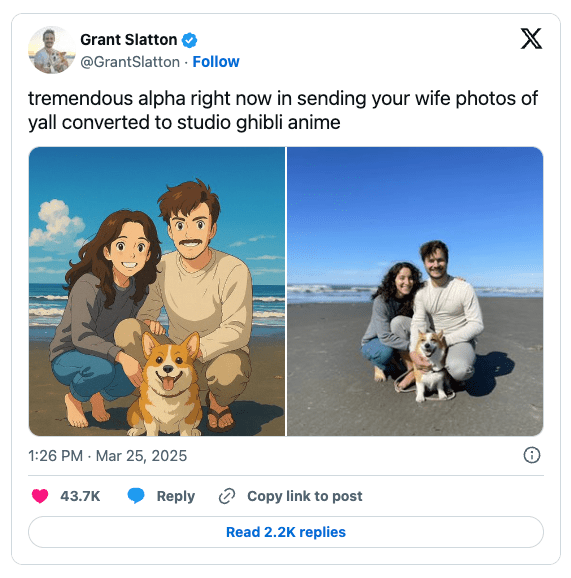
Just look at the recent Studio Ghibli style photos that became so popular they caused OpenAI’s “servers to melt” and made Sam Altman restrict access to creating them. This is OpenAI’s digital media moment.

The Tweet that made the Studio Ghibli craze go viral this week
Why the time is now
As mentioned earlier, there are 5 conditions making this the ripe time:
- a new technology breakthrough that enables new media creations
- stagnating incumbents
- Dense pent-up talent from the 2010 era
- New distribution channels, and
- An ecosystem awash with capital
A few examples of how the tech incumbents are stagnating:
- Social media usage has plateaued in the USA
- Meanwhile, platforms like Instagram and Snapchat now resemble something closer to digital shopping malls — spaces that are more focused on advertising than true social connection. 75% of Gen Z users report feeling disconnected from social media platforms that prioritize monetization over meaningful interaction.
- TikTok is the only platform that has grown to reach 1 billion users in the last decade — no rival has replicated its viral growth.
Incumbent’s stagnation has created an innovation gap. For the first time in years, startups have a shot at building something new — and AI is the catalyst.
NFX published some great charts showing the consumer slump we are now in.

NFX image
History repeats and why consumer should re-emerge in 2-3 years
History also tends to repeat itself – and big waves of consumer came after technology breakthroughs.
Notice something about the companies in the NFX graph above? Consumer waves came in 2 clusters after 2 technology breakthroughs:
- Browsers like Netscape and Mosaic in 1994
- The iPhone was introduced in 2007
Consumer breakthroughs consistently follow major tech shifts by 2-6 years – and AI should be no different.
- Mosaic and Netscape browsers (1994) → Yahoo!, Amazon, eBay, PayPal, Google (1995-1998).
- iPhone (2007) → Snapchat, Instagram, Uber and Robinhood (2010-2013).
- ChatGPT debuted in November 2022 – we are 2.5 years into it. The consumer wave should be starting now.
Timing alone won’t guarantee success, but a pattern has become clear – when the core tech starts shifting, its ability to connect people socially naturally does as well.
This creates opportunities.
Consumer interest in AI-powered experiences is rising fast – with 65% of Gen Z now preferring AI-assisted content creation tools over traditional apps (GWI, 2024).
As incumbents struggle to integrate AI in meaningful ways – or, if they fail to take advantage of the new social paradigm that emerge when we talk to the net, not just through it – startups will have an opening to forge a brand new titan once again.
Why AI is the Catalyst
AI isn’t just a content tool. It’s redefining how people connect and engage.
As Michael Sayman puts it, AI is shifting social from “talking through the internet” to “talking with the internet itself.”
This evolution is unlocking powerful new dynamics:
- Users can co-create with AI tools like Character.ai or Chai, turning conversations into creative experiences.
- AI-generated content is becoming more engaging – from music remixes to text-to-video to personalized stories.
- AI provides real-time feedback, enabling interactive experiences that adapt on the fly.
Emerging platforms like Inworld and Scenario are blending AI with social storytelling, allowing users to shape dynamic narratives together. Early adopters are embracing this shift: 40% of Gen Z say they now spend more time interacting with AI chatbots than traditional social platforms.
AI-powered experiences are already gaining traction across several categories:
- AI Chat – Perplexity, ChatGPT, and others are redefining conversational interaction.
- AI Companions – Platforms like Character.ai and Chai are reshaping digital companionship.
- AI Digital Twins – Virtual personas powered by AI hint at a new form of online presence.
- AI in Gaming – Tools like Inworld, Scenario, and others are embedding AI into immersive experiences.
- AI Image/Video generators – DeepAI, OpenArt, Submagic, Akool, Photoroom,
- AI Homework helpers – MagicSchool, Solvely, Praktika, etc.
The opportunity lies in blending these tools with the new social models that they themselves are enabling. A platform that combines AI-driven creation, social collaboration, and immersive experiences could become the next breakout juggernaut.
But AI will create all the media and incumbents are too powerful….
A common rebuttal I hear is that no new consumer social platform can emerge because 1) AI will create all our media 2) incumbents are too powerful and acquisitive.
First – I strongly believe that in a world where AI content is a foregone conclusion, content that is clearly made by humans becomes premium.
Second – incumbents are building AI tools themselves, have entrenched social graphs that are hard to beat, and consumers are saturated, but Meta’s strategy seems to shows an acquisitive portfolio approach to successful consumer breakouts may still mean an independent brand can break free before being acquired.
Finally, consumer breakthroughs are always orthogonal and seemingly come out of nowhere. We won’t know until it hits us.
Conclusion
The conditions that fueled Facebook’s rise are reappearing: a perfect storm of tech breakthroughs, social change, and an innovation gap. AI is the catalyst this time, and startups are better positioned than ever to deliver the next big thing all over again.
The next breakout social platform will prioritize AI-driven creation, unlocking new ways for people to connect, collaborate, and consume content.
 Mercedes Bent
Leave a comment