
Defensibility in the Age of AI Search
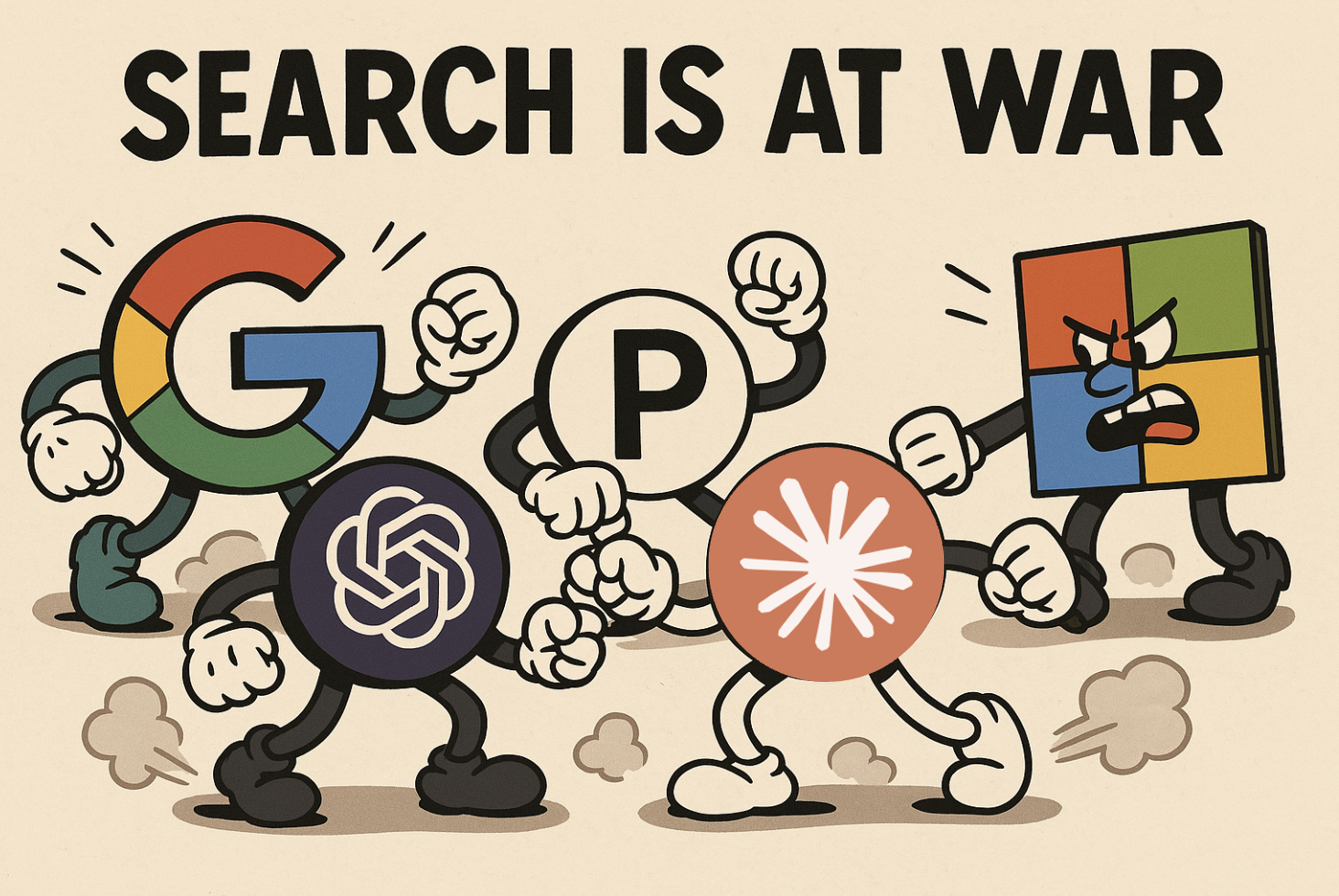
Search is at war.
LLMs are quickly changing how consumers search. A lot is at stake, including the market caps of 2 of the top 5 most valuable companies in the world. Google (GOOG: $1.9T market cap) and Amazon (AMZN: $2.04T) each dominate different types of search: knowledge and product searches.
As a consumer investor, I believe everything about how consumers find, evaluate and make purchasing decisions online is about to change.
This leads me to wonder what the most defensible area of search will be. Will Google, Instagram or Amazon die? Likely not anytime soon, but by the time it begins, the writing will be on the wall.
(Spoiler / hot take: I think most defensible is network-driven entertainment.)
My thesis is that defensibility in next-gen search will be determined by 3 major factors:
- How ai interfaces evolve: how naturally, contextually, and multimodally users can interact with a search. What “dial” are users given?
- How recommendations and reviews are reinvented: in an AI-first world where you assume all information you read is AI-made, human recommendations become premium. How will AI replicate?
- Speed of ai-to-real-world supply chain rollout: how long it takes AI-to-real-world supply chain to reach maturity. Can agents complete payments? Initiate supply chain gears?
These 3 factors are tools chatbots are missing in optimizing the conversion funnel:

Whoever can maintain supremacy in these areas will be more defensible.
My framework for figuring this out starts with how I break down search into its 4 jobs to be done*:
- knowledge / information
- entertainment
- goods
- services
Today different incumbents own each of these categories:

The defensibility of each search category will vary depending on how the 3 factors – interfaces, reviews, and real-world supply chain connections – develop for that specific type of search.
Of the 4 jobs to be done in search, here’s my ranking of Most to Least defensible:
- Entertainment – original human made IP is still valuable and social graph / networks are incredibly durable (6/10 defensibility)
- Goods – top of funnel will be disrupted swiftly, but reviews and logistics will be sticky (4/10 defensibility)
- Services – this will be reinvented swiftly (3/10 defensibility)
- Knowledge – this is already being disrupted (2/10 defensibility)
Below I’ll go through each of these 4 search categories to share more about why I gave this ranking.
Also a caveat – this is all around search as we know it today – on mobile, desktop screens. Once we have a new platform / hardware shift (Meta’s Ray Ban glasses), search completely resets.
Knowledge (Informational Search)
This is already ground zero. Today the models highest usage categories are knowledge / information searches: software development questions, homework help, tech trouble shooting, health / fitness advice, etc. Users aren’t just looking for links anymore, they’re looking for answers. And increasingly, that means they’re turning to LLM based chats.

We’re watching a fundamental shift in the search contract. Google indexes sites. LLMs synthesize them. Friction is lower. Signal is higher (versus noise). Feedback loops are faster. We are heading toward a world where keyword search feels overwhelming and less intuitive for many questions that require a “back and forth” interaction.
This is already eating into Google’s market share. In the last quarter of 2024, Google’s global search market share dipped below 90% for the first time since 2015, averaging 89.6% over three months.
Defensibility?
Google still has a chance to win. Gemini is really good. The problem is a) interfaces and b) Google needing to decide if it will cannibalize itself.
Traditionally model providers have competed on data sources, training and inference methods, and model parameters. It feels like we’re reaching a phase where improvements in those areas are incremental (data being one of the last moats, no longer training).
There is a really big white space for an ai chatbot to reinvent text-based search by giving the user more control over how they prompt and how they interact with the results that are served.
Differentiation in interfaces will come from proprietary feedback loops, introduced at the interface level with user interaction data.
Finally – Alphabet has a number of portfolio plays – Waymo, Cloud, and Adwords can be inserted into Gemini as needed – that give them defensibility. I don’t expect their revenue to come crashing down overnight.
That said, the gap they need to manage is Google owns 89% of browser search generally, and only 13% of Chatbot search.
Browser search is still much bigger however. As a proxy, Google saw 542M daily visits in January 2025, while ChatGPT saw 18M daily visits.
The cannibalization risk for Google is that if they try to replace their browser search (89% market share) with Gemini / chatbot (right now they’re separate apps), Google hasn’t unoptimized the flow and loses retention on Gemini.
One key question is whether chatbot search expands the number of searches people do, or if it takes market share and people are shifting behavior.
I give knowledge search a 2 / 10 defensibility score.

Entertainment
LLMs haven’t made a huge dent in entertainment. Yet. Text isn’t immersive. YouTube, TikTok, Instagram, Netflix, and gaming companies (Sony, Tencent, Microsoft, EA, Nintendo, Roblox, etc) still own the attention stack. But video and gaming models are progressing fast and that’s going to change.

From Altimeter Capital – they expect revenue to transfer from Creators to Tech Enablers
AI-native storytelling, embodied chat interfaces, and multimodal agents will redraw the line between entertainment and interaction. Platforms like Character.ai, Sora, Pika and Luma are early signs. Imagine a world where personalized movies and tv shows are made just for you based on your interests. Or even about your own life with you as the main character (remember “Joan is Awful” the Black Mirror episode?). You don’t just watch content, you interact with it. Or better yet, it adapts to you in real time.
When AI interfaces develop more naturally, and ai-video storytelling matures, entertainment platforms will be more at risk. Reading text in chat is not the most entertaining. Character is an interesting start with personifying chat.

Made with Sora. It’s cool, but still a novelty.
Defensibility?
For traditional video entertainment like Netflix, defensibility will come from format innovation, storytelling and IP. The winners here will be the ones who invent new entertainment paradigms native to AI become too personalized, participatory, and persistent to lose. Interface evolution for entertainment will be key. Here interface evolution won’t be about user input (users are more passive when being entertained) but about innovation in consumption interfaces.
For social media video entertainment, defensibility lies in the network. Social graphs are entrenched. People still want to know what their friends are doing.
I also think human-made stories are really defensible. In a world where everyone assumes content is made by AI, human-made stories become premium. I expect entertainment studios to begin branding themselves as human made and using that as a selling point. Taste is one of the most human traits, and following the bleeding edge artists’ taste has survived for millenia.
Of the 3 primary entertainment revenue pools (gaming, digital media and social media) – I think gaming is the least defensible given developments in AI-generated world models. Gaming is developed by game engines which are essentially running code to produce framed experiences – and AI is very good at code. Social media and digital media are made with more hands-on human made processes.
Hot take, but I think entertainment is the most defensible of the 4 search categories, and that Netflix / Instagram are more defensible than Sony / EA.
I give entertainment search a 6 / 10 defensibility score.
Goods
Amazon dominates product search. 56% of consumers start their product searches on Amazon, surpassing search engines (42%) and other retailers.
But even Amazon struggles with full-funnel discovery. It’s optimized for when you know what you want, not when you don’t.
LLMs will close that gap. Picture a system that handles intent fuzziness, compares options across retailers, applies coupons, handles checkout, and schedules delivery autonomously.
You know that friend you go to to work things out? You come in all jumbled, and they sort you out? LLMs are that friend.
Amazon should hopefully already be working on this. I asked for a gift for my niece and got the results below.
AI’s edge won’t come from catalog size. It’ll come from end-to-end actionability. Think personalized shopping agents that get smarter over time, with memory, context, and real-world integrations.

Amazon results when I ask for a gift for my niece
Defensibility?
Amazon’s defensibility today lies in fulfillment and the trust that engenders. Amazon’s moat is more than Prime, it’s reliability, logistics, and consumer confidence. For challengers, owning last-mile infrastructure or embedding into trusted environments (like iOS or WhatsApp) is a tall order.
But there are already many “idea to my front door” businesses. For example, you can “text prompt” to create your own jewelry at this point.
I don’t believe the large LLMs will orchestrate their own fulfillment in the short term. But moving product search to LLMs is not as tall a task. Especially if they figure out reviews and recommendations.
So I expect Amazon’s search interface to be less defensible but their supply chain is very defensible.
I give goods search a 4 / 10 defensibility score.
Services
This is the messiest and most up-for-grabs category. The internet is already pretty bad at recommending the right services so this feels up for grabs (Yelp, Craigslist, etc).
I’m really excited for AI to tackle this part of search because this will be net positive value creation, expanding the amount of services consumed. I expect blue-collar work and national GDPs to expand thanks to increased consumption.
Finding and booking real-world services (plumbers, tutors, accountants, etc.) is still clunky. Vertical marketplaces like Yelp, Angi, and Thumbtack feel outdated and transactional.
Dan Hockeimer of Faire has a great essay on why we haven’t seen any $10B services marketplace. The real problem is that people don’t know what they want.
Now layer in LLMs with calendar access, payment rails, reputation scores, and past preferences. Suddenly you’re not searching for a service; you’re delegating to an agent who clarifies intent fuzziness, indexes services in a way a sku-based system can’t, knows your preferences, and books accordingly.
Defensibility?
There isn’t a clear winner here today (maybe Angie’s List, Craigslist, Yelp) and I don’t expect these businesses to have much defensibility. Yelp’s catalog of reviews is the most defensible. Vendor networks, real-world integrations, and verified reputation layers.
Whoever can plug AI into the messy, high-stakes world of real-life service delivery, with quality control and customer trust, can win. Think Uber + GPT, but modular and verticalized.
I give services search a 3 / 10 defensibility score.
In Summary
The next leader in search won’t win because it mimics Google. It will win because it replaces the current notion of search. It’ll do it by mastering the 3 vectors of defensibility:
- Interfaces evolution
- AI native recommendations and reviews
- AI-to-world execution layer
Of the 4 jobs to be done in search, here’s my ranking of Most to Least defensible:
- Entertainment – original human made IP is still valuable and social graph / networks are incredibly durable
- Goods – top of funnel will be disrupted swiftly, but reviews and logistics will be sticky
- Services – this will be reinvented swiftly
- Knowledge – this is already being disrupted
Thanks for reading!
 Mercedes Bent
Leave a comment