
The PLG Playbook Series: Building bottom-up adoption companies is HARD. Like ridiculously hard. This is a series about how every element of consumer or PLG company building is undergoing change & sharing the building blocks no one talks about. Even as everything changes, PLG or Consumer is defined by its evergreen pillars: its scale – something millions of people can use; by its GTM – low/touch no touch sales; and by its purchase power – agency to spend, no approval needed.

We all have that one friend who forgets everything – the dinner plans they made, the movie you recommended, even the story they told you last week. You still love them, but do they seriously need to get their head checked? (that friend is me in my friend groups when it comes to what stories I already told, I’m sorry friends).
That’s what most consumer products feel like today. Every time we open a shopping app, a bank portal, or a fitness tracker, it greets us like a stranger. It has all the data in the world but none of the context. No memory or continuity.
But memory is changing.
It’s been a little over a year since OpenAI first began rolling out persistent memory in ChatGPT (September 2024). You’ve probably noticed that your chat answers now incorporate past memories you’ve logged in other chats.
I had this experience the other day when I asked a question about positioning, and was surprised when chatGPT responded not theoretically, but personally to me, Mercedes, about my firm’s positioning!
This could reshape user interactions. Imagine if your banking app opened with, “Last week you asked about wire limits – want to finish setting that up?” Or if your shopping assistant remembered your toddler’s shoe size, your taste in colors, and your budget ceiling.
The infrastructure to make this possible has been built, but hasn’t been widely adopted yet.
We’re entering the era of Memory as an AI Service: a foundational layer that lets products retain context across sessions, devices, and even across apps. It’s the shift from stateless to stateful consumer experiences, from repetition to recall.
One of the big questions as this infrastructure rolls out is how will the market structure evolve?
In today’s world, founders face a choice: Do you build & manage your own memory system – expensive, compute-heavy, but deeply integrated into your architecture – or do you rely on a third-party provider that handles storage, recall, context engineering and integrations for you?
It’s the same debate companies had in the early days of the cloud. Back then, the skeptics said, “You’ll never outsource something that core.”
Then AWS happened.
The same dynamic is unfolding now. Memory will either be managed by each company or emerge as a third-party service layer, in instances where businesses that don’t feel this part of the tech stack is critical to own.
Either way, consumer founders will now need a memory strategy just as surely as they once needed a digital marketing strategy and a cloud storage strategy .
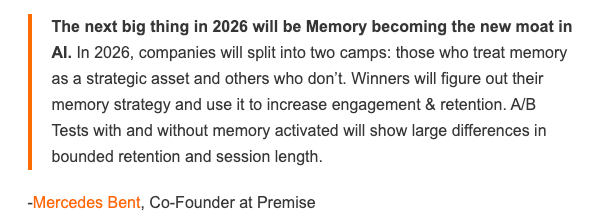
In the new era of consumer AI, recall could become an incredibly powerful tool for retention. I am envisioning that in the near future, web 2.0 / mobile web businesses will be running retention regressions comparing memory-assisted retention versus non-memory-assisted retention.
I. The Rise of Memory as an AI Service
So what is memory? In technical terms, “memory” means a model’s ability to persist information across sessions. To recall what a user said before and use it to improve future interactions.
I won’t dive too deep here – but memory is essentially the use of external systems and techniques to store and retrieve data beyond the model’s transient internal context window. The model itself is fundamentally stateless and does not inherently remember past interactions once a session ends. This persistence is an architectural addition, not an intrinsic part of the core model’s function. The process to establish memory includes the following steps: information extraction, external storage (long-term memory), retrieval, context injection, and dynamic management.
The largest research labs began rolling out memory in 2024: OpenAI rolled out ChatGPT in June 2025, Anthropic rolled out memory in Claude in August 2025, Perplexity in June 2025.
But last year another crop of smaller startups also began rolling out memory and context for agents as a standalone third party service: SuperMem, Mem0, Mem.ai, Hyperspell, Letta, Zep and more (MemGPT is an open-source version).
These startups exist because day by day there’s a different model that’s the most performant. As a business you want to be able to change out the underlying models for whichever one is currently wining, whether it’s OpenAI, Anthropic, or Google.
I’m calling this new class of infrastructure Memory as an AI Service. It sits between data storage and the user interface. It doesn’t replace LLMs; it enriches them.
And just like cloud computing, memory might bifurcate:
- Vertical providers embedded in major AI ecosystems (OpenAI, Anthropic) – memory is included in ChatGPT for Enterprise
- Horizontal third-parties that offer memory APIs across tools (Hyperspell, Supermemory, MGPT, Mem.ai) – purpose built for specific verticals or use cases (enabling agents to have memory, customer support focused, etc)
For founders, that’s the strategic fork in the road. The question isn’t just can your app remember, it’s who controls what it remembers.
II. The build-buy-partner decision
If you’re a consumer founder, how will you decide whether to build your own, buy a complete AI solution – chatGPT for enterprise, or partner with a 3rd party service for memory?
It will likely come down to:
– Your scale
– Engineering capacity
– How much you are building your own agents
– What amount of the tech stack you want to own
– How much you care about working with the most performant models
– Whether you’ve specialized in context engineering or have a need for it
If you care about working with most cutting edge model and don’t want to stay on top of which model that is month-to-month, then you may prefer to work with a memory-as-a-service provider.
Buy ChatGPT/Claude or partner with a memory-as-a-service provider?
There’s benefits to both. The MAAS providers will ensure your agents are interacting intelligently with your context sources, and help them learn repeatable tasks.
III. The Cloud Analogy
When cloud infrastructure first appeared, people thought no serious company would outsource something as critical as hosting. “You need to own your servers,” they said. Then AWS, GCP, and Azure proved that abstraction and specialization create efficiency and speed.
Memory is heading the same way. Right now, most companies are building bespoke solutions in-house: databases, custom vector stores, and context windows managed internally. But as memory architectures standardize, the economic logic will shift: centralized providers will offer cheaper, smarter, and more integrated options.
The danger, as always, is graduation risk. The technical debt that accrues when you as a startup outgrow your vendor. Founders need to plan for that early: if your product relies on a third-party memory layer, how easily can you migrate when you hit scale? What happens when the cost of compute tips in favor of owning it yourself? The memory-as-a-service companies will need strong lock-in to avoid being a bootstrapping sector.
The companies that think through that transition now and its potential pitfalls will scale more gracefully – similar to those who architected their products cloud-natively before the rest of the industry caught up.
IV. Portability and Segmentation: Two Forces Shaping the Future of Memory
Two parameters will define how memory evolves: portability and segmentation.
Portability is the idea that users will want to carry their AI “self” across experiences. You might build rapport with your agent in ChatGPT, but you’ll want that same memory when you move into Instagram, your car interface, or your AR glasses. A portable memory layer would allow users to have one coherent sense of “self” across digital life. Now most of the memory-as-a-service teams are building for agentic enterprise use cases today, but if memory does evolve this way, its possible. This future also assumes that humans are still navigating to websites. In the future an agentic web experience might see me streamline all web navigation through a single agent.
Segmentation pushes in the opposite direction. Just as we maintain separate identities at work and in our professional, we’ll maintain distinct memory domains. Work you doesn’t want your therapy app or parenting assistant dipping into its context.
Time will tell which of these memory properties will prove to have a stronger pull on the market’s evolution.
The winning consumer products will respect both continuity where it’s useful and separation where it’s essential.
Despite what I’ve written above, portable memory is unlikely. Centralized entities don’t have great incentives to allow 3rd party memory into their experience. What’s best for the consumer isn’t always how the market evolves.
V. How Persistent Memory Changes Retention and UX
Once products start remembering, every aspect of engagement shifts. In a world where there’s still humans navigating to apps:
- Session Length extends: You stop reintroducing yourself to your own tools. The first five minutes of every session no longer repeat what the last five minutes of the last session did. Memory is a tool for increasing user’s depth with your product, and depth tends to lead to longer sessions.
- Onboarding converts higher: If memory is truly portable, this could improve the onboarding funnel for many startups. Instead of a “start fresh” mindset, you pick up where you left off — a more natural, less fatiguing relationship.
Examples of how this could unfold include your wellness app reminding you that you logged poor sleep after late workouts, or your bank app noting that every month you transfer money right after payday and preemptively asking if you’d like to automate it.
There’s a really fun UX challenge in designing how to show memory: when to surface it, when to hide it, and when to forget.
V. A Tactical Playbook for Founders
Consumer founders are now faced with a new kind of product decision: how to design, govern, and deploy memory.
Here’s a tactical checklist to anchor that thinking:
Use Case Match
- What do I need memory for? Internal use cases (agents I’m building for internal tooling) or is this customer facing?
Build vs. Buy
- Have I already tried building this myself – are we domain experts at context engineering?
- When would compute costs justify bringing it in-house?
- What percentage of our user interactions would meaningfully improve with memory?
- Could a third-party provider deliver 80% of that value faster?
Data Ownership & Privacy
- Who owns the stored memories – the company, the vendor, or the user?
- Can users port or delete their data easily?
- How do we protect against over-personalization or “creepy” recall?
Experience Design
- How will users know what’s remembered, can they correct or erase it?
- Do we need different memory domains (work, personal, social)?
Integration & Scalability
- Which contexts feed our memory layer – support tickets, emails, spend activity, engineering activity logs, etc?
- What’s our “graduation plan” if we need to migrate from a third-party to in-house?
VI. Closing Reflection: Memory as a new consumer Engagement lever
The holy grail in consumer is strong user engagement and retention. We in consumer land obsess over the idea of cohorts that have asymptoting retention or even those elusive ones with a smile.
I’ve become increasingly convinced that the consumer startups who figure out product design around memory first will be those that have much higher retaining users. If deployed correctly, you can create some pretty magical experiences. Consumers adopt and retain products when the experience is 10x greater than the past.
Every relationship gets stronger through memory. That’s as true in life as it is in product design.The forgetful friend (that’s me) is finally learning to remember.
The next great products will be intelligent and attentive. And in a world where attention is fleeting, giving users the super power to remember, will win.
I can’t wait to see consumer engagement be redefined by agentic memory!
 Mercedes Bent
Leave a comment