This is one of the most common questions I hear from founders at the preseed and seed stages.
Headlines constantly glorify $500M, $60M, and $27M seed rounds. But $500k and $2M are also super common.
How can a founder know what they can raise?
Fundraising can be an enigma, but I believe fundraising also has an equation.
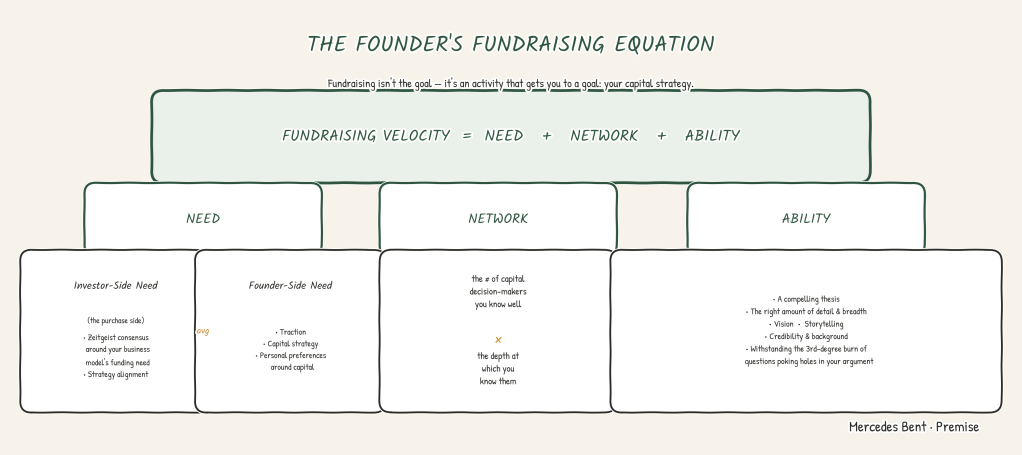
When I think through what determines how much a founder can or should raise, my fundraising back of napkin math looks something like:
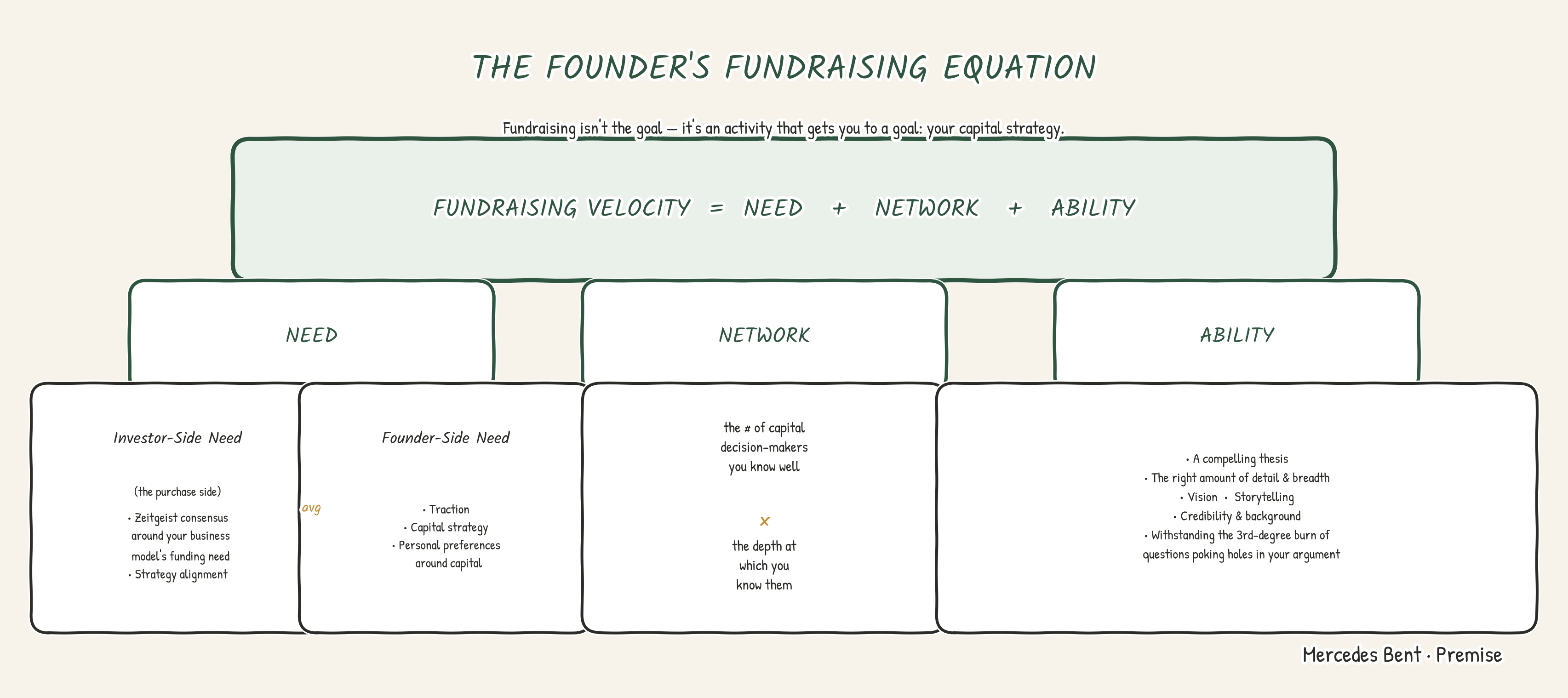
Fundraising Velocity = need + network + ability
Why I made this
I was inspired to create this after a conversation with a founder who wanted to raise a $45M round out of the gate. When I pushed them on why, what they would use the money for, and the explanation fell flat.
It didn’t feel like they’d thought through the nuts and bolts of their strategy – who their customer would be, the wedge product, how they would go to market.
One of my biggest learnings after becoming an investor is that the depth of an answer – the number of reasons you conjure to support an argument (which frequently should be at least 5 to 6 valid, logical, reasons – you can start with 2 or 3) and the ability to speak them with confidence to answer any question, is directly correlated with how thoughtful the listener perceives you to be.
As a daughter of an engineer, I always preferred brevity and conciseness. But powerful oral communication requires using what seems like a superfluous number of words to elucidate an argument, to display the insides of your brain, for your listener.
What the Equation Means
Need
- What it is: Investor Need (Purchase side = zeitgeist consensus around business model funding need + Strategy alignment)
- What it is: Founder Side Needs (Traction + capital strategy + personal preferences around capital). If your traction demands more dollars (need to hire people to support revenue growth, that is strong need). Or if you’re a research lab and have a fixed cost for training costs, that is also a high need.
- Commentary: Need is not just how much money do I need to hire a team or spend on marketing. It’s a 2 way need where capital “matches” once its found its fit. Personal preferences around bootstrapping or dilution also greatly affect the “need” or demand for capital – companies growing extremely fast with large profits don’t “need” to raise for monetary reasons – but there are plenty of non-monetary “needs” – signaling market leadership, validation of a valuation for pricing employees stock, and much more.
Network
- What it is: The number of capital decision makers you know well * the depth at which you know them.
- Commentary: Often the fastest fundraises I see are ones where a repeat founder goes back to market – they’re already met dozens of investors their first go around. My rule of thumb: if you can text 40 investors and more than half will hop on a call this week – that’s a strong network. I’d advise collecting a list of hundreds of VCs and not just going after the known names.
Ability
- What it is: A compelling thesis, the right amount of detail and breadth, vision, storytelling, credibility, background. Ability is where being able to withstand the 3rd degree burn of questions poking holes in your argument really comes into play.
- Commentary: There’s often a view that some people are born natural fundraisers. I don’t think that’s true. I wrote about “influential communicators” 2 years ago and its still true.
How to use it
Typically a very strong investor network is correlated with fundraising ability – you’ve met more investors in the past and built close relationships because you’re a strong fundraiser.
If you’re just getting started, focus on building your Ability with your existing Network, asking them for feedback on the pitch, before extending your network broader to other VCs you don’t know.
There’s an adage that “The first look is the best look.” VCs are trained on making snap judgements and despite saying “this is just a feedback meeting” are still judging your thought processes and may not take the next call when you’re actually ready to raise.
Here are a few illustrative examples of how I’d use the framework.(Scores of 1 to 10 possible for each category)
- Fresh college grad who doesn’t know VCs, company has skyrocketed to $3M in live ARR within 3 months of launching the company, in a category within the zeitgeist (AI dev tools for example), who has medium ability – good natural instincts on customers and what they need, green on metrics / company building. Let’s say that might score as:
- Network = 1
- Need (Investor) = 8
- Need (Founder) = 9
- Need Total (average of 8 and 9) = 8.5
- Ability = 3
- Fundraising Velocity = 1 + (8.5) + 3 = 12.5
- Experienced operator with 10 years of work experience (early thirties), spun out of web1 or web2 success – say Palo Alto Networks or Stripe, never launched a startup before, 0 traction to date, but an idea informed by their experience in a zeitgeist area (AI spending):
- Network = 4
- Need (Investor) = 8
- Need (Founder) = 2
- Ability = 4
- Fundraising Velocity = 4 + (5)+ 4 = 13
- Research team from Stanford PhD building a new research lab, with a top Stanford professor joining the cofounding team in an area with zeitgeist (RSI)
- Network = 7
- Need (Investor) = 5
- Need (Founder) = 8
- Ability = 4
- Fundraising Velocity = 7 + (6.5) + 4 = 17.5
- Founders with 3 years of work experience, $45k ARR after 3 months, consumer monetization without AI, no prior startup founding experience:
- Network: 1
- Need (Investor): 2
- Need (Founder): 2
- Ability: 3
- Fundraising Velocity = 1 + (2) + 3 = 5
- Previous founder of an exited VC backed company that returned over $200M to investors, now building in AI, with cofounders they worked with before and new AI talent, with $2M in contracted revenue coming out of the gate, working on a agent evals tool or agentic servicing company.
- Network: 9
- Need (Investor): 8
- Need (Founder): 8
- Ability: 9
- Fundraising Velocity = 9 + 8 + 9 = 26
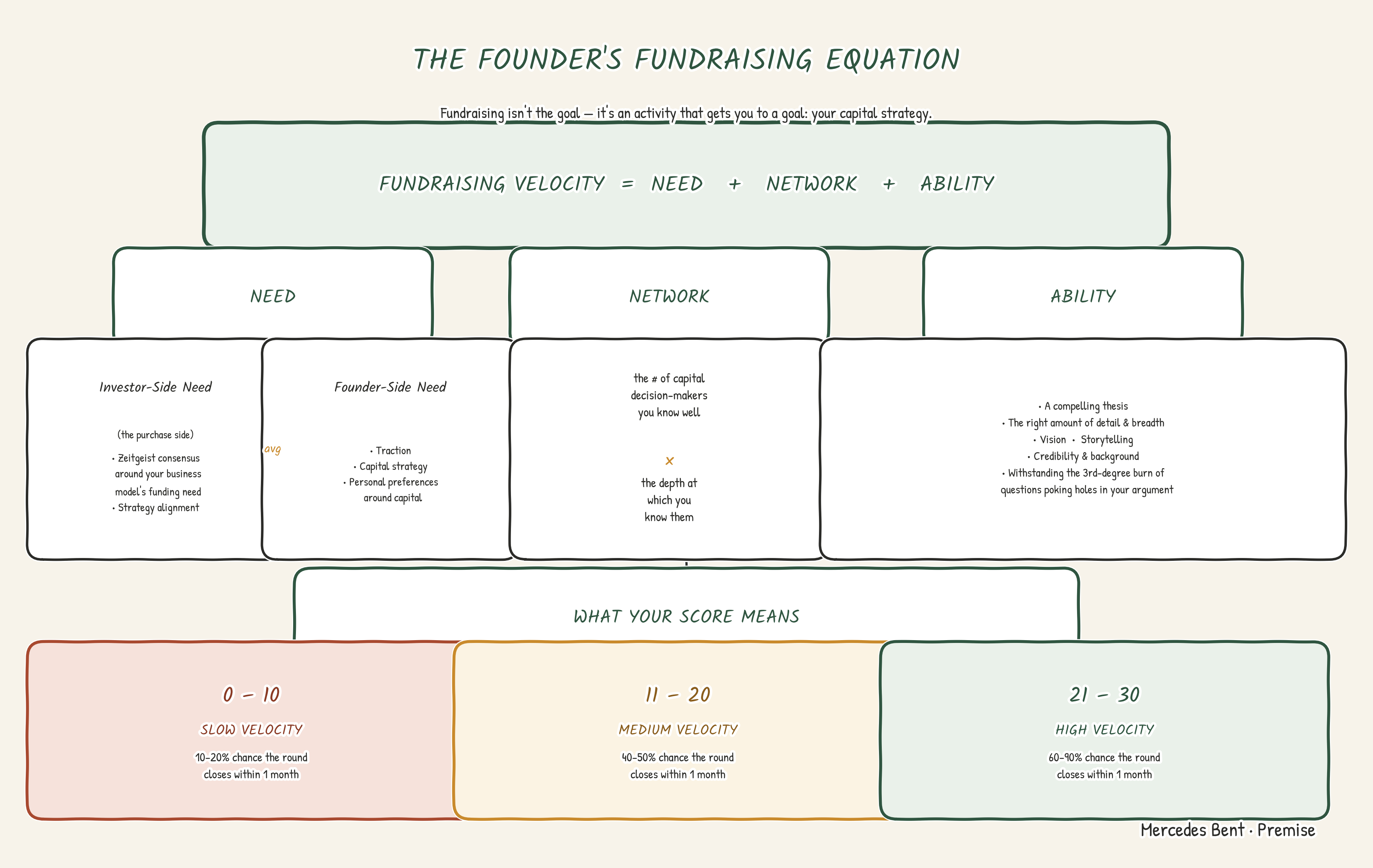
My rough rule of thumb on how likely your fundraising ask will be met quickly (fundraising velocity) using this framework is:
0 – 10: Slow fundraising velocity: 10-20% chance round done in 1 month
11 – 20: Medium fundraising velocity: 40-50% chance round done in 1 month
21 – 30: High fundraising velocity: 60-90% chance round done in 1 month
p.s.
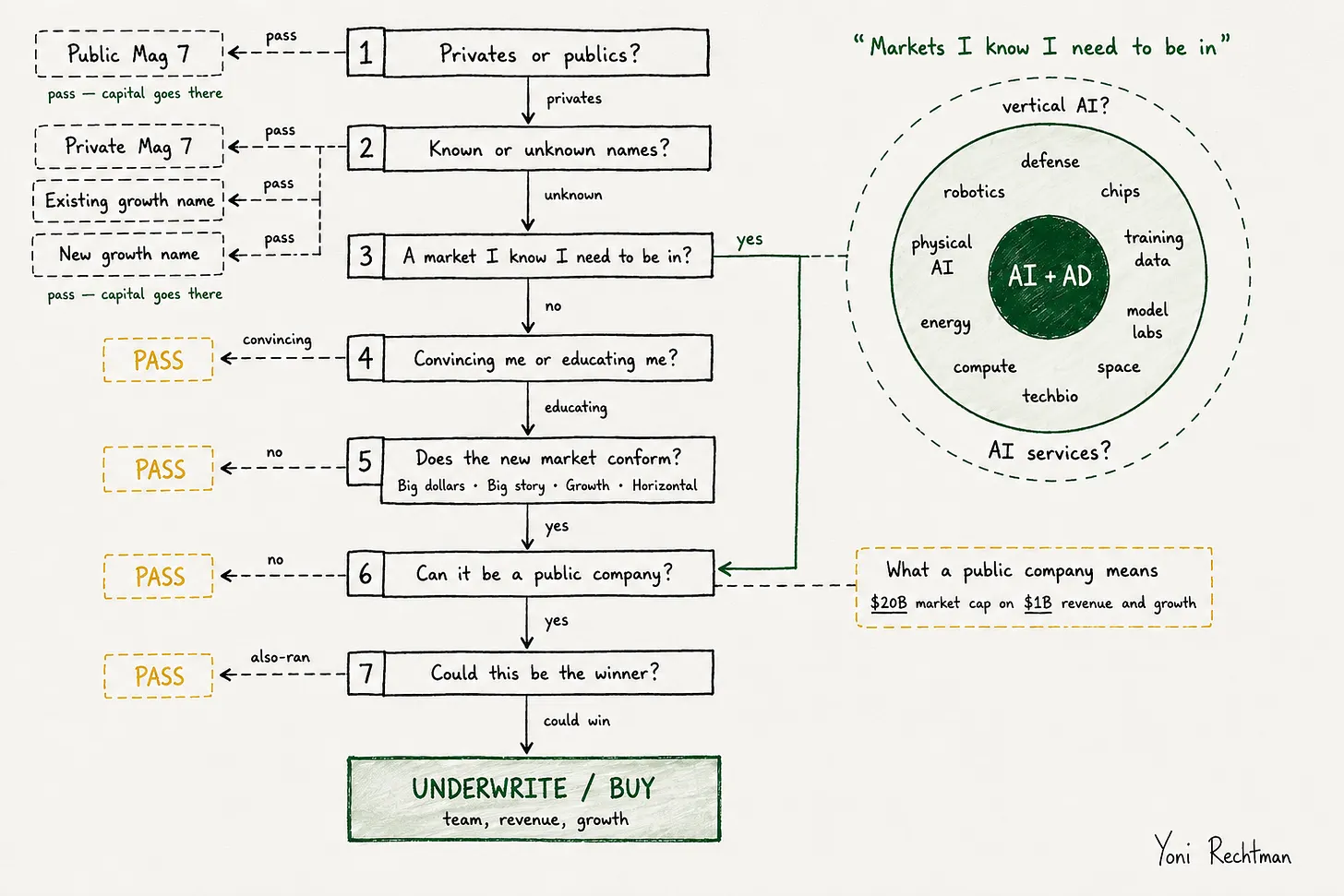
Thanks to Yoni Rechtman at Slow, whose post on “What Capital Wants” inspired me to turn this framework I’d written down into a blog post. My focus was more on the founder’s abilities which is after his points 1-3
p.s. This is an extension of my #FMB “Founders are Made, not Born: How Founders Become Learning Animals” series. Originals based on research at Stanford: Part I, Part II, Part III, Part IV, Part V, Part VI, and Part VII. Extensions: Parts 7, 8, 9, 10, 11, 12, 13, 14, 15.


Leave a Reply